
The Great Books Project Beyond the Great Books
In the Shadow of the Sword
Every account of how the faith began was written down generations after the fact. Holland asks what a historian can actually know, and why the answer runs through two exhausted empires rather than an empty desert.
What It Is
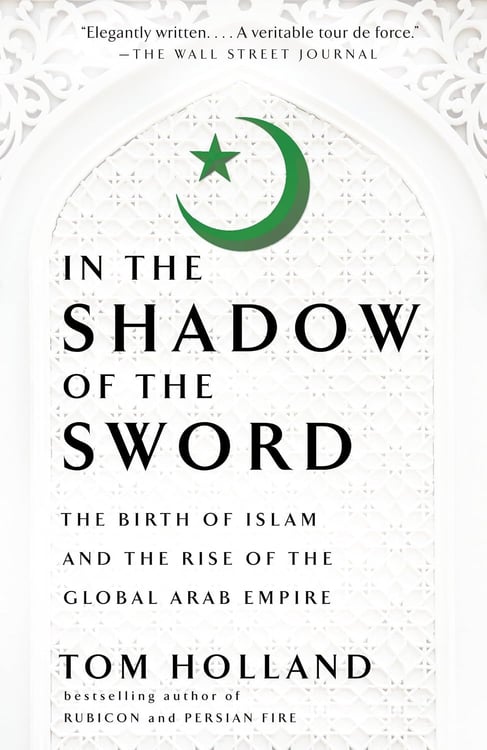
A narrative history of the Near East from the sixth century to the eighth, published in 2012, built around a question most popular histories of the period avoid: how do we know any of it? Tom Holland had already written Rubicon and Persian Fire, and he brings the same method here, a big, peopled story told with a novelist's timing, to the last stretch of antiquity, when Rome and Persia bled each other white and a new power walked in from the margins.
For its first two hundred pages the book is only glancingly about Arabs. It is about the Sasanian shahs and the Christian emperors, the rabbis of Mesopotamia and the monks of Syria, plague, prophecy and the war of 602 to 628 that left both empires hollow. That is deliberate. Holland's argument is that the new faith was born into this world and shaped by it, and he wants you to know the world before you meet the faith.
Expect a historian who shows his working. Holland keeps stopping to tell you where a story comes from, when it was written down, and what that does to its reliability. The notes are long and worth reading.
Why It Matters
The problem Holland puts on the table is real and uncomfortable. The earliest surviving biography of the Prophet reaches us through an editor who died two centuries after him, and the great collections of sayings are later still. For most of the seventh century the Arab empire is better documented by Christian chroniclers, coins and a building inscription in Jerusalem than by any text from inside it.
Scholars have argued about what to do with this since the 1970s. Holland was the first to carry the argument to a general audience in prose anyone can read, and he pushes further than most academics are willing to, including on where the scripture's landscape of olives and cattle might actually sit. He was attacked from both directions: by historians who thought him careless and by people who thought the question itself an offence. A Channel 4 film made from the book had a screening cancelled after threats. Agree with his conclusions or not, the book makes it impossible to say "the sources tell us" without asking which sources, and when.
It is also the best single account of why late antiquity matters, a period most readers skip between the fall of Rome and the Crusades.
Before You Read
Eighteen to twenty hours. Moderate: the prose is easy, the cast is enormous and the geography is unfamiliar. Keep the maps at the front bookmarked and expect to consult the list of names often.
Patience with the first two hundred pages pays off. Every piece of the Persian and Roman material is load-bearing later.
Know going in that this is a revisionist book. It argues with the traditional account and says so. If you want that account told straight first, Montgomery Watt's chapter in the Cambridge History of Islam will give it to you in an evening, and Holland reads better as a cross-examination afterwards.
Which Edition to Read
- Anchor paperback (US, 2013), subtitled The Birth of Islam and the Rise of the Global Arab Empire — recommended. The complete text with the maps, timeline, list of names and the full notes, at a paperback price, and the edition American readers will actually find in stock. The cost: the maps are small for a book that leans on them. View on Amazon →
- Doubleday hardcover (US, 2012). The same text in a sturdier binding, now mostly secondhand. Worth it if you annotate.
- Abacus paperback (UK). The same book under a different subtitle and jacket. Buy whichever is cheaper.
Read it in print. The notes and maps are half the argument, and an audiobook cannot carry either.
Getting the Most From This Book
Read the notes. Holland's method lives there: the dates of the sources, the scholars he is leaning on, the places where he admits the evidence runs out. A reader who skips them finishes a confident story; a reader who follows them finishes a historian's argument.
Hold the two halves together. Each time an Arab ruler does something in the second half, ask which empire he learned it from. That question is the book.
Pair it with the traditional account rather than replacing it. Holland is a prosecutor, and a prosecutor is more useful once you have heard the defence.
And do not treat his boldest suggestions as settled. He is careful to mark where he is speculating; be as careful reading as he was writing.
Some links on this page are affiliate links. Purchases made through them help support the Great Books Project at no additional cost to you.


